It’s Sunday evening. You’ve finally finished the week’s work, and your business blog has been sitting untouched for months.
You write a quick update about a busy week, add a few photographs and press publish. A week later, almost nobody has read it. No new enquiries came through.
It’s reasonable to wonder whether blogging is worth your time. Before deciding, look at the question your article answers. Is it something a potential customer would actually search for?
Start with the question your customer is trying to answer
Imagine you run a cleaning business in Sydney’s north.
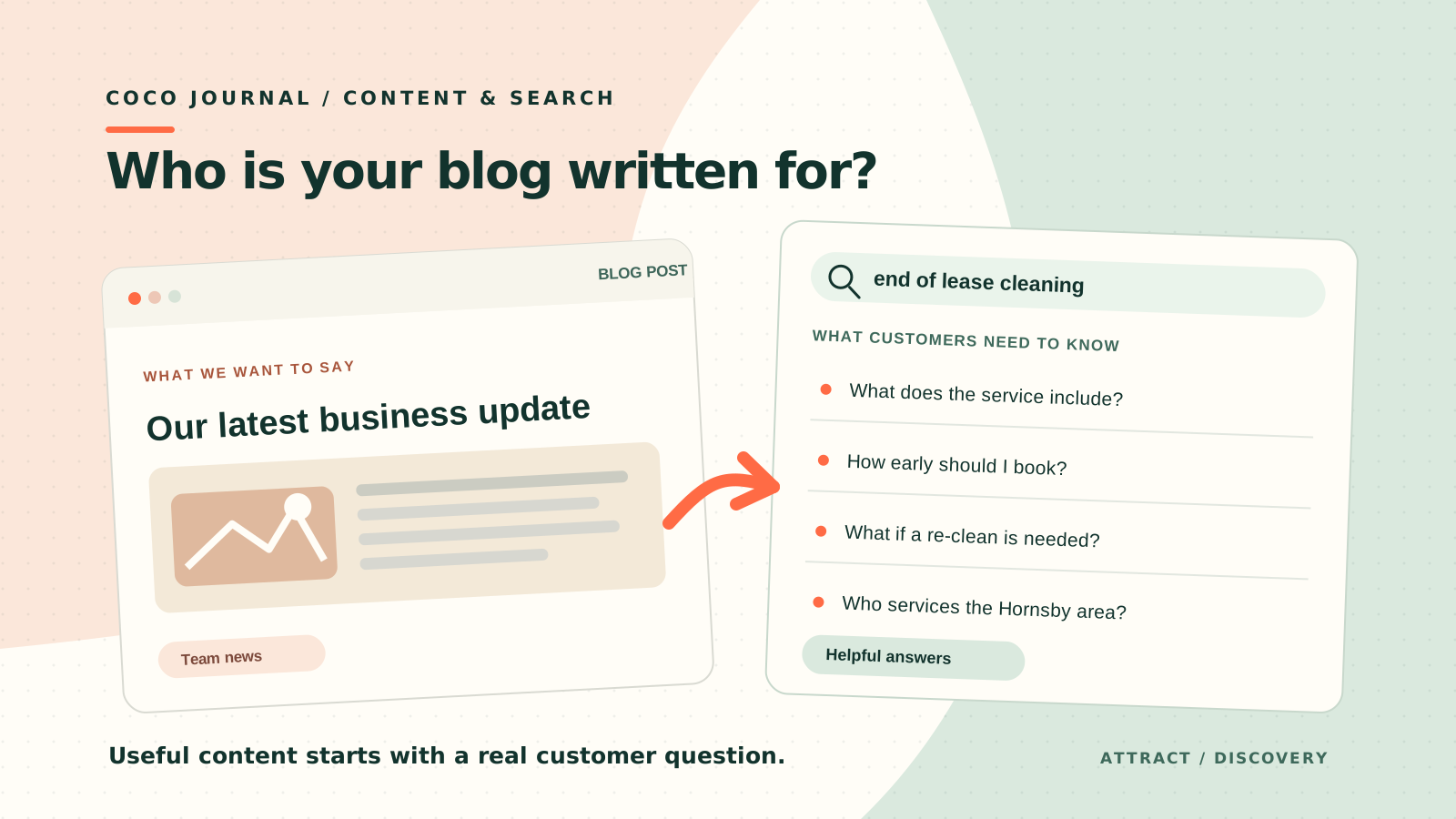
Your latest post is titled “Another busy week for our team”. Existing customers may enjoy it. But a person preparing to move out of a rental is probably looking for something else:
- What does end of lease cleaning include?
- How far in advance should I book?
- What if the agent requests another clean?
- Can I find a cleaner who works in Hornsby?
Those are examples, not verified search-volume data. They illustrate how a customer’s immediate need differs from a business announcement.
A useful blog post meets the reader at that moment. It explains the answer clearly and gives the reader a sensible next step.
Use real customer conversations to choose topics
You don’t need to start with a complicated keyword tool. Open your recent emails, messages and enquiry notes.
Look for the questions you keep answering. A beauty salon may hear questions about what happens at a first appointment. A tutoring business may hear how parents should choose an age-appropriate class. A home-service business may hear what a quote includes.
Write down the questions in the customer’s words. Then check whether people also search for them. Search results, Google Search Console and keyword research tools can help you test your assumptions.
Frequently asked questions are a starting point, not proof that a topic has search demand. And high search volume alone is not proof that an article will attract paying customers.
Give readers something they can use
Consider two titles for a salon article:
- “We offer professional facial treatments”
- “Your first facial: what to ask before booking”
The second makes a clearer promise to an unfamiliar reader. The content now needs to fulfil that promise.
Explain what a first-time customer should expect, what the service may or may not suit, what information the salon needs and how someone can prepare. Avoid blanket claims where individual circumstances matter.
A long page of “best service” and “experienced team” claims won’t answer those questions. Clear explanations, practical limitations and genuine business knowledge are more useful.
Google’s people-first content guidance supports this approach. It encourages original, helpful content written for readers rather than pages made mainly to influence search rankings. SEO still matters, but it works best when it helps people discover useful answers.
Make the next step obvious, without pushing a sale
Some readers are researching options. Others are ready to book.
A post about cleaning services could link to the relevant service page, explain the suburbs covered and provide a clear way to request a quote. A training business could link to class schedules and enrolment details.
You don’t need a sales pitch in every paragraph. You do need a reasonable path forward for someone who finds the article useful.
Keep links specific. Sending every reader back to the home page adds unnecessary work when a more relevant page exists.
Publish at a pace you can maintain
Small-business owners have enough to manage: enquiries, scheduling, staff, invoices and life outside work.
There’s little benefit in forcing out a post every Friday if you have nothing useful to add.
Start with one question that repeatedly comes up before a customer buys. Answer it well. Check the information periodically, especially if prices, service areas or booking conditions change.
An article that remains accurate and useful for months can be worth more to your business than a stream of updates written only to fill the calendar. But even a well-written article is not guaranteed to rank or generate enquiries.
Measure what happens after the visit
Page views are useful, but they don’t tell the whole story.
Suppose one post attracts people looking for free DIY instructions. Another draws fewer readers, but some go on to view your service page or request a quote. The second may be more valuable to your business, even with lower traffic.
Google Search Console’s Performance report helps you see queries, impressions and clicks from Google Search. Website analytics can help you observe subsequent service-page visits and enquiry actions. Neither proves a completed sale without checking the actual business records.
Review the path from question to answer to enquiry. Use what you learn to improve your content rather than chasing a single traffic number.
The first article is probably already in your inbox
At Coco, we start by understanding the work a website must do for its owner and its customers. For a local service business, that often means making practical answers easy to find and the next action easy to take.
If your website has a blog that rarely gets used, you may not need a new content calendar. You might need to turn one question you answer every week into a genuinely helpful page.
Our SEO and search visibility services can help you review what people find, where information is missing and which improvements are worth making.
Talk to Coco if you want to make better use of the knowledge you already share with customers.